
The Varieties of Religious Experience
A psychological study of individual religious experiences across traditions.

William James · Public domain
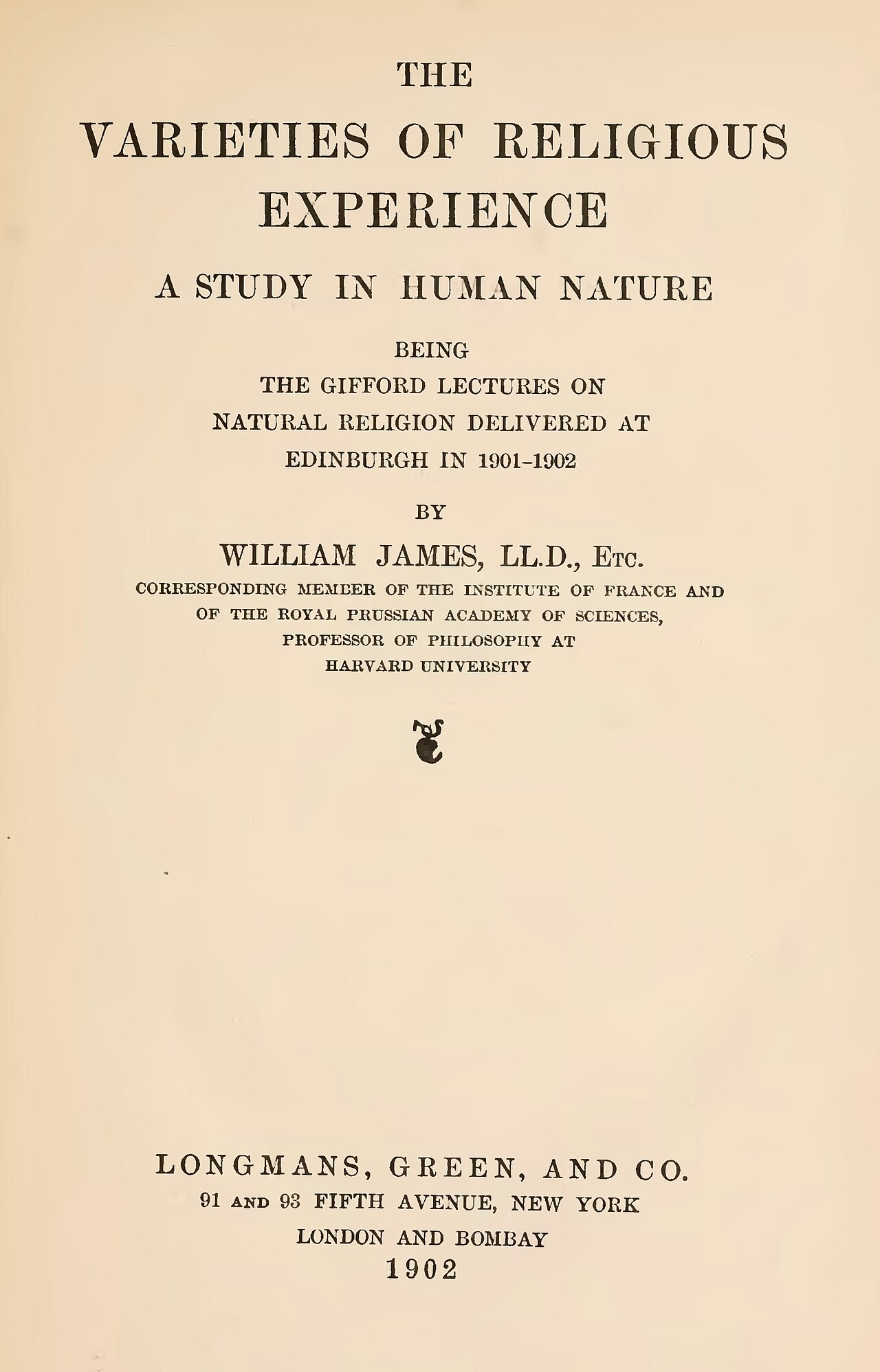
The Varieties of Religious Experience: A Study in Human Nature is a book by Harvard University psychologist and theologian William James. The lectures focus on the psychological study of individual private religious experiences and mysticism, using a range of examples to identify commonalities across traditions. Soon after publication, the book entered the Western canon of psychology and philosophy and has remained in print for over a century.
- author
- William James
- field
- Psychology, Philosophy, Theology
- known_for
- Psychological study of religious experience, mysticism, pragmatism
- key_concepts
- Healthy-minded religion, sick soul, mysticism markers (ineffability, noesis, transience, passivity), over-beliefs
Lore & Background
James originally planned a philosophical assessment of religion for the second half, but ill health limited him to one lecture on that topic, making the work more descriptive than intended. He thanks Edwin Diller Starbuck for providing a large collection of manuscript material, which James used throughout the book. James explicitly excludes theology and religious institutions, focusing instead on direct, immediate religious experiences, which he considers more interesting. He distinguishes between healthy-minded religion (emphasizing life's goodness) and the religion of the sick soul (grappling with evil), and he regards the sick-souled experience as preferable, with an anonymous autobiographical source in lectures VI and VII.
Reader's Guide
The Varieties of Religious Experience is significant for establishing the psychology of religion as a field, emerging from the 'new psychology' of the 1890s that emphasized laboratory methods and separation from philosophy and theology. James outlines four markers of mystical experiences: ineffability, noesis, transience, and passivity. He argues that religious experiences, though possibly having morbid origins, are largely positive and often life-altering. The book's pragmatic approach—evaluating religion by its uses—influenced James's later philosophy of pragmatism, though philosopher Richard Rorty contends that James ultimately abandoned pragmatism in the work by relying on empirical evidence for the value of saintly virtues. James also introduces the concept of 'over-beliefs,' beliefs not strictly justified by universal reason but understandably held, and he states his own over-belief in a greater reality accessible through religious experience. The book's legacy includes its enduring place in the Western canon and its influence on the study of religious experience.
Did You Know?
- James originally planned a philosophical assessment of religion for the second half of his lectures, but ill health limited him to one lecture on that topic.
- The anonymous source of melancholy experience in lectures VI and VII is autobiographical.
- James considered healthy-mindedness to be America's main contribution to religion, running from Emerson and Whitman to Christian Science.
- Richard Rorty argued that James ultimately abandoned his own pragmatist philosophy in the Varieties due to reliance on empirical evidence.
From Edinburgh Lectures to a Lasting Text
The book's genesis traces back to a prestigious invitation: the Gifford Lectures, a series established by Adam Gifford to bring natural theology to broad, public audiences. What makes the origin story particularly interesting is what the book almost was. James had envisioned the second half as a full philosophical assessment of religion, but persistent ill health curtailed his ambitions, leaving him with only a single lecture on that topic. The finished work therefore leans more descriptive than James originally intended, a consequence of his physical limitations rather than a deliberate editorial choice. The research foundation was no less substantial. James drew heavily on the manuscript collection of Edwin Diller Starbuck, whose earlier Psychology of Religion he had even prefaced. Starbuck recalled James poring over several hundred documents, and the influence of that archive runs throughout the text.
The Healthy-Minded and the Sick-Souled
Perhaps the most structurally significant move in the book is James's division of religious temperament into two broad categories: the healthy-minded and the sick-souled. The healthy-minded embrace a theology centered on life's inherent goodness, while the sick-souled wrestle with an inescapable sense of evil that no amount of optimism can dissolve. James frames this as a neutral typology, yet the text betrays a clear personal leaning. The anonymous account of deep melancholy that anchors lectures six and seven is, in fact, James's own autobiographical material, and he ultimately privileges the darker, more searching religious experience over its cheerful counterpart. From these deeply personal sections, the work pivots into lectures nine and ten, where conversion is examined as a psychological event of historical significance. James also situates healthy-mindedness as distinctly American, tracing a lineage from Emerson and Whitman through Mary Baker Eddy's Christian Science, and even defends the mind cure as a rational alternative to the limited medicine of his era.
Four Markers of the Mystical
Two dedicated lectures give mysticism the most systematic treatment in the book, and James distills it into four defining characteristics. Ineffability means the experience resists verbal capture and must be lived to be grasped. Noesis frames it as a form of knowledge through which divine truths become accessible. Transience marks it as brief, a flash rather than a permanent state. Passivity underscores that the subject cannot summon or dismiss the experience at will; it arrives and departs on its own terms. What sets James apart from more dismissive critics is his nuanced stance on origin and value. He acknowledges that religious experiences can spring from brain pathology and can be irrational, yet he insists they are overwhelmingly positive in their aftermath. Unlike the confused thoughts produced by fever or intoxication, the insights gained in a mystical episode typically retain their coherence and are treasured for a lifetime. Though his illustrative examples skew heavily toward Christianity, James makes clear he does not intend to bind his framework to any single tradition.
Pragmatic Roots and a Century in Print
The Varieties occupies a unique position at the intersection of psychology, philosophy, and theology, and its afterlife reflects that. Within years of publication it had secured a place in the Western canon of both psychology and philosophy, and it has remained continuously in print for well over a century, a remarkable endurance for a work born from a university lecture series. Its pragmatic underpinnings are particularly noteworthy. James argues that the practical benefits religion confers on individuals and, through them, on the wider world, constitute the strongest case for its truth, citing the therapeutic power of prayer as a concrete illustration. The philosopher Richard Rorty has argued, however, that James ultimately drifted away from strict pragmatic methodology within the lectures, especially in his treatment of saintliness, where the goal shifts toward asking whether virtuous qualities genuinely enrich human life. The book thus stands as both a product of the new experimental psychology of the 1890s and a bridge toward a broader philosophical project.
Gallery

Frequently Asked Questions
Who wrote The Varieties of Religious Experience?
The book was authored by William James, a Harvard University psychologist and theologian who was also a leading figure in the pragmatist philosophical movement.
What does The Varieties of Religious Experience actually study?
It is a psychological investigation of individual, private religious experiences and mystical episodes drawn from multiple faith traditions, seeking common patterns in human experience rather than comparing doctrines.
What are the four markers of mysticism James identifies?
James proposes ineffability, noetic quality, transience, and passivity as the four hallmarks that distinguish a genuine mystical state from other forms of religious feeling.
What's the difference between 'healthy-minded' and 'sick soul' religion in the book?
James contrasts an optimistic, easy-going religious temperament with a more troubled, introspective one that wrestles with doubt, suffering, and the darker dimensions of existence.
Why is The Varieties of Religious Experience still considered important over a century later?
The work entered the Western canon of psychology and philosophy almost immediately after publication and has stayed in continuous print, continuing to shape how scholars frame the psychology of belief and mystical experience.
More in Philosophy & Theory 1-24
Spotted an error? Know more?
This is a living reference — every entry is fact-audited, and reader corrections feed straight into our audit queue. Suggest an edit · See this site's audit record