
The Road to Serfdom

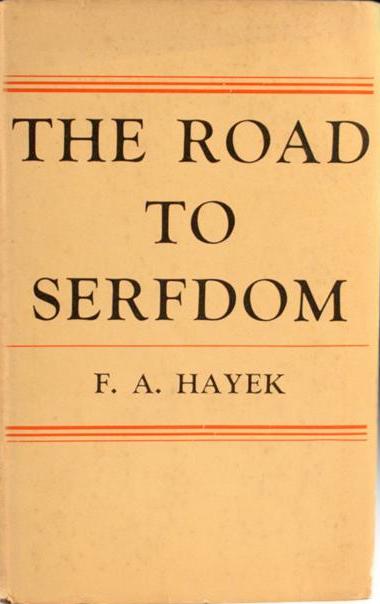
The Road to Serfdom is a book by the Austrian-British economist and philosopher Friedrich Hayek. The book argues that abandoning individualism and classical liberalism results in loss of freedom, an oppressive society, and the serfdom of the individual. It has been influential among classical liberal and conservative thinkers.
- author
- Friedrich Hayek
- field
- Economics, philosophy
- nationality
- Austrian-British
- known_for
- The Road to Serfdom
- publisher_UK
- Routledge
- publisher_US
- University of Chicago Press
Lore & Background
The Road to Serfdom was written by Friedrich Hayek while he was a professor at the London School of Economics. It began as a memo to William Beveridge disputing the claim that fascism was a capitalist reaction against socialism. The memo grew into a magazine article, and Hayek ultimately decided to write it as its own book. The title was inspired by the 19th-century French thinker Alexis de Tocqueville's phrase 'road to servitude'.
Reader's Guide
The Road to Serfdom has had a significant impact on 20th-century political discourse, especially American conservative and libertarian economic and political debate. The book argues that centralized planning is inherently undemocratic and leads to totalitarianism, and that fascism, Nazism, and state-socialism share common roots in central economic planning.
Did You Know?
- The book was rejected by three US publishers before being accepted by the University of Chicago Press.
- The book is dedicated 'To the socialists of all parties'.
The Central Warning: Planning as the Path to Tyranny
Hayek's core argument is that government control of economic decision-making through central planning inevitably produces tyranny. He contended that abandoning individualism and classical liberalism leads to an oppressive society, dictatorial rule, and the subjugation of the individual. A particularly striking element of his thesis was his direct challenge to a view popular among British Marxists: that fascism and Nazism were merely a capitalist backlash against socialism. Hayek rejected this framing entirely, arguing instead that fascism, Nazism, and state-socialism all shared common roots in the concentration of economic power in the state and the elevation of collective authority over individual liberty. He saw centralized planning as inherently undemocratic, requiring the will of a small minority to be imposed on the broader population, and warned that under such systems the individual becomes merely an instrument serving abstract goals like social welfare. His famous contrast—that a competitive economy's worst resort is a bailiff while a planned economy's ultimate sanction is the hangman—encapsulated his belief that even the poorest enjoy more genuine freedom in an open society than in a centrally directed one.
From a LSE Memo to a Wartime Bestseller
The book's origins trace back to a memo Hayek wrote to William Beveridge, the Liberal politician and dean of the London School of Economics where Hayek held a professorship in the early 1930s. That memo, which pushed back against the prevailing claim that fascism was the death rattle of a failing capitalist system, expanded into a magazine article and was initially meant to feed into a larger planned treatise. Hayek ultimately broke it off as a standalone work. The publisher had modest expectations of nine hundred to three thousand sales, yet the initial two-thousand-copy printing vanished almost immediately, and thirty thousand copies had been sold within six months.
Reaching Far Beyond the Academy
Hayek's work found its widest audience not through academic channels but through popular media. The book has since been translated into roughly twenty languages.
A Book Dedicated to Its Critics
The Road to Serfdom carries a dedication reading "To the socialists of all parties," a pointed gesture toward the very audience Hayek most wanted to reach. The title itself draws inspiration from the nineteenth-century French classical liberal Alexis de Tocqueville and his writings on the road to servitude. Originally conceived as the popular edition of the second volume of Hayek's broader treatise, The Abuse and Decline of Reason, the book was designed to translate complex economic philosophy into accessible prose. Its impact on twentieth-century political discourse has been substantial, particularly in shaping American conservative and libertarian economic and political debate. Hayek's argument that socialism, despite its professed humanitarian aims, could only be implemented through methods most socialists themselves would disapprove of, and that such systems require effective propaganda to convince citizens the state's goals are their own, resonated far beyond economics. His insistence that democracy pursues equality within liberty while socialism achieves equality through coercion and subjugation became a foundational reference point for decades of free-market political thought.
Gallery
Frequently Asked Questions
Who wrote The Road to Serfdom?
Friedrich Hayek, an Austrian-British economist and philosopher, authored the book.
What is the central argument of The Road to Serfdom?
Hayek contends that rejecting individualism and classical liberalism inevitably produces an oppressive society in which personal freedom is eroded. The title itself signals his warning that centralized planning leads not to liberty but to a form of modern serfdom.
Which publishers released The Road to Serfdom in the UK and the US?
Routledge handled the UK edition, while the University of Chicago Press issued the American version.
What academic fields does The Road to Serfdom belong to?
The work sits at the intersection of economics and political philosophy, blending market theory with a broader argument about how free societies are structured and preserved.
Why is The Road to Serfdom still widely cited today?
It remains a cornerstone text for classical liberal and conservative thinkers who caution against the expansion of state power over individual lives.
More in Philosophy & Theory 1-24
Spotted an error? Know more?
This is a living reference — every entry is fact-audited, and reader corrections feed straight into our audit queue. Suggest an edit · See this site's audit record