
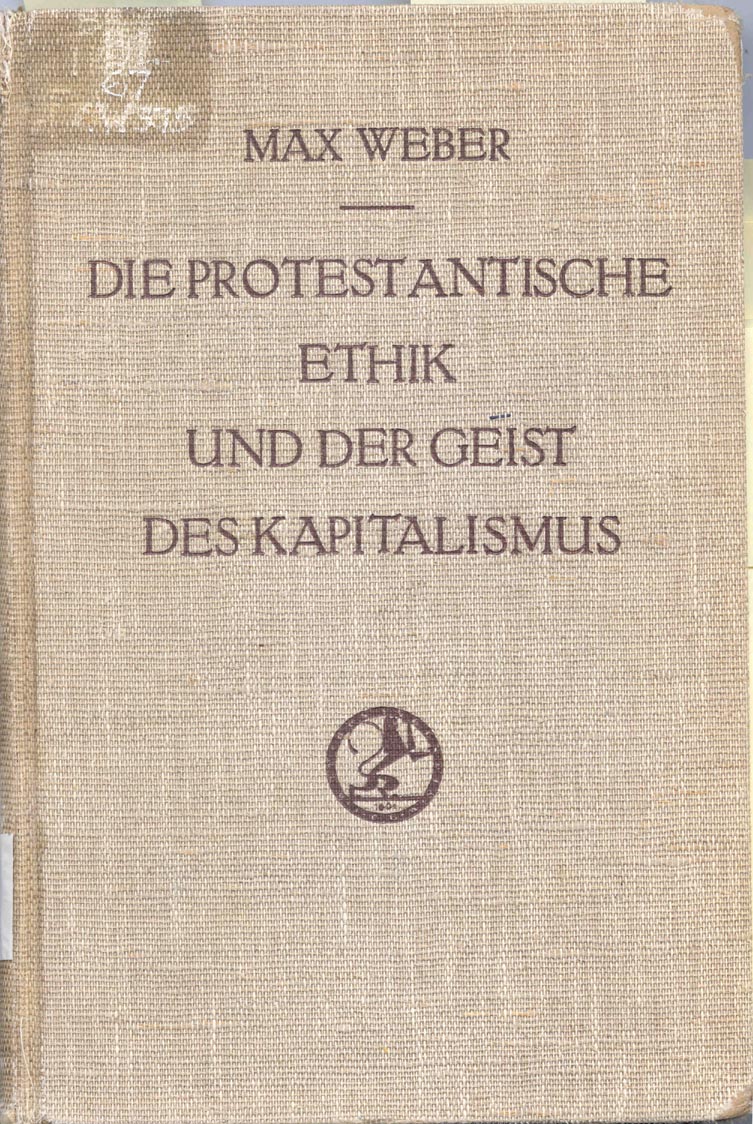
The Protestant Ethic and the Spirit of Capitalism
Argues Protestant ethics influenced the rise of modern capitalism.

Max Weber · Public domain
The Protestant Ethic and the Spirit of Capitalism is a book by Max Weber, a German sociologist, economist, and politician. The work is considered a founding text in economic sociology and a milestone contribution to sociological thought.
- author
- Max Weber
- field
- Sociology, economics, politics
- nationality
- German
- known_for
- The Protestant Ethic and the Spirit of Capitalism
Lore & Background
In the book, Weber wrote that capitalism in Northern Europe evolved when the Protestant (particularly Calvinist) ethic influenced large numbers of people to engage in work in the secular world, developing their own enterprises and engaging in trade and the accumulation of wealth for investment. He discusses Calvinists, Lutherans (especially Pietists), Methodists, Baptists, Quakers, and Moravians. Weber argues that religious devotion is usually accompanied by a rejection of worldly affairs, but the Reformation profoundly affected the view of work, dignifying even mundane professions as a 'calling' blessed by God. He quotes Benjamin Franklin's ethical writings to illustrate the 'spirit of capitalism' as a set of values favoring hard work and progress, not mere greed.
Reader's Guide
The Protestant Ethic and the Spirit of Capitalism is a foundational text in economic sociology, arguing that Puritan ethics and ideas influenced the development of capitalism. Weber defines the 'spirit of capitalism' as the attitude that systematically strives for profit for its own sake, as exemplified by Benjamin Franklin. He notes that this spirit is not limited to Western culture but that heroic entrepreneurs alone could not establish a new economic order. The work traces the origins of the Protestant work ethic to the Reformation, particularly the doctrine of double predestination among Calvinists, which led believers to seek worldly success as a sign of salvation.
Did You Know?
- Weber discusses not only Calvinists but also Lutherans, Methodists, Baptists, Quakers, and Moravians.
Origins and Publication Journey
The book we know as The Protestant Ethic and the Spirit of Capitalism did not arrive in the world as a single, polished volume. Max Weber, a German scholar who wore the hats of sociologist, economist, and politician, first composed the work as a connected series of essays. For nearly three decades, the text remained largely confined to German-speaking academic circles. That translation proved transformative: it helped cement the work's reputation as a foundational text in economic sociology and a landmark in the broader history of sociological thinking. Weber himself positioned the essays as an introductory chapter for his later, more ambitious comparative studies of religion and economics in China, India, and ancient Judaism, suggesting he saw the Protestant material as one thread in a much larger tapestry.
The Architecture of the Argument
Weber's central claim is that the rise of modern capitalism in Northern Europe was shaped by a particular cluster of Protestant values, especially those rooted in Calvinism. He defines the spirit of capitalism not as some metaphysical force but as a practical orientation toward hard work, systematic profit-seeking, and reinvestment of earnings. Crucially, he insists this is not a philosophy of simple greed. His illustration draws on Benjamin Franklin's moralizing prose about time as money and capital as a breeding sow, language saturated with religious duty rather than avarice. Weber contrasts this with precapitalist labor patterns, where raising a wage often led workers to shorten their hours rather than extend them, since they judged the same earnings could be obtained with more leisure. He also argues that the Reformation redefined ordinary labor—cobbling, farming, trading—as a sacred calling, a vocation blessed by God. Yet he cautions that isolated entrepreneurial heroes could not alone build a capitalist order; the ethic had to become a shared way of life across whole communities.
A Mosaic of Confessions
Although Calvinism occupies the central stage, Weber's analysis is far broader than a single denomination. He devotes attention to Lutheran Pietists while carefully distinguishing their outlook from that of traditional Lutherans and from Calvinist theology. Methodists, Baptists, and Quakers each receive discussion as groups whose religious disciplines reinforced disciplined labor and frugal reinvestment. The Moravian community at Herrnhut, operating under the spiritual direction of Count von Zinzendorf, is singled out as a particularly vivid example of a collective whose entire social organization was shaped by religious devotion and productive work. Weber is careful to note that the spirit of capitalism, understood as an individual attitude, is not exclusive to any one faith or even to the West. What he identifies as distinctive is the way these particular Protestant traditions wove economic activity into a moral and spiritual framework, making the rational, systematic pursuit of gain feel like an obligation rather than a temptation. This breadth of denominational coverage gives the work its comparative sociological texture, even though Weber himself framed it as a preliminary study rather than a comprehensive history of Protestantism.
Enduring Scholarly Standing
More than a century after its initial publication, the work continues to anchor debates in sociology and the history of economic thought. It placed behind only three other works: Weber's own Economy and Society, C. Wright Mills's The Sociological Imagination, and Robert K. Merton's Social Theory and Social Structure. Its status as a founding document of economic sociology means that virtually every subsequent theorist who examines how belief systems shape market behavior must reckon with Weber's framework, whether to extend it, challenge it, or recontextualize it within newer empirical findings.
Gallery


Frequently Asked Questions
Who wrote The Protestant Ethic and the Spirit of Capitalism?
Max Weber, a German sociologist, economist, and politician, is the author. The book is his most widely recognized contribution to academic thought.
What is the main argument of The Protestant Ethic and the Spirit of Capitalism?
Weber contends that the moral values embedded in certain Protestant traditions helped create the cultural conditions that made modern capitalist enterprise flourish. He does not claim religion caused capitalism directly, but rather that it shaped the underlying spirit behind it.
What academic field does The Protestant Ethic and the Spirit of Capitalism belong to?
The book is a foundational text in economic sociology, though it also touches on economics and political thought. It is widely regarded as a landmark in sociological reasoning.
Why is The Protestant Ethic and the Spirit of Capitalism considered important?
It established a framework for understanding how cultural and religious values can shape economic behavior at a societal level. The work remains a standard reference in discussions of capitalism's origins and is viewed as a milestone in the development of sociological thought.
Does The Protestant Ethic and the Spirit of Capitalism argue that Protestantism directly caused capitalism?
Not exactly; Weber argues that Protestant ethics helped cultivate a particular attitude toward work, discipline, and accumulation that aligned well with capitalist enterprise. The relationship he describes is one of cultural influence rather than simple cause and effect.
More in Philosophy & Theory 1-24
Spotted an error? Know more?
This is a living reference — every entry is fact-audited, and reader corrections feed straight into our audit queue. Suggest an edit · See this site's audit record