
The Structure of Scientific Revolutions

Thomas Kuhn · Public domain
Kuhn. Its publication was a landmark event in the history, philosophy, and sociology of science. Kuhn challenged the then prevailing view of progress in science as 'development-by-accumulation' of accepted facts and theories, arguing instead for an episodic model of normal science interrupted by revolutionary science and paradigm shifts.
- author
- Thomas S. Kuhn
- field
- History, philosophy, and sociology of science
- known_for
- Introducing the concept of paradigm shifts and challenging the cumulative view of scientific progress
- publisher
- University of Chicago Press (first published as a monograph in the International Encyclopedia of Unified Science)
Lore & Background
While reading Aristotle's Physics, he found Aristotle's concepts of matter and motion astonishingly unlike Isaac Newton's work, initially appearing full of errors. Kuhn concluded that Aristotle's concepts were not 'bad Newton,' just different, and that one must be aware of scientific conventions of the time to appreciate earlier reasoning. This insight became the foundation of the book. By the mid-1980s, however, his book had achieved blockbuster status. Kuhn's book contributed to the idea of 'structure,' an intellectually popular word in many fields in the humanities and social sciences in the early 1960s. One theory to which Kuhn replies directly is Karl Popper's 'falsificationism,' which stresses falsifiability as the most important criterion for distinguishing scientific from unscientific. Kuhn also addresses verificationism, a philosophical movement that emerged in the 1920s among logical positivists.
Reader's Guide
The Structure of Scientific Revolutions fundamentally altered the understanding of scientific progress by arguing that it does not proceed through the straightforward accumulation of facts, but rather through paradigm-driven shifts. Kuhn's episodic model—periods of 'normal science' characterized by puzzle-solving within an accepted paradigm, interrupted by revolutionary science triggered by accumulating anomalies—challenged the prevailing view of science as a linear, cumulative enterprise. The book launched the word 'paradigm' into widespread analogical use in the second half of the 20th century. Kuhn's insistence that a paradigm shift was a mélange of sociology, enthusiasm, and scientific promise, but not a logically determinate procedure, caused an uproar. For some commentators, the book introduced a realistic humanism into the core of science; for others, it tarnished the nobility of science by introducing an irrational element into its greatest achievements. The book remains a cornerstone in the history, philosophy, and sociology of science, influencing fields far beyond its original scope.
Did You Know?
- Kuhn's analysis of the Copernican Revolution noted that it initially did not offer more accurate predictions than the Ptolemaic system, but appealed to practitioners based on a promise of better solutions.
The Core Argument: Paradigms and Revolutionary Breaks
Kuhn's central thesis dismantled the assumption that science advances through steady accumulation of facts. Instead, he proposed an episodic model in which long stretches of normal science—periods of puzzle-solving within an accepted framework—get punctuated by revolutionary breaks. In his account, anomalies gradually pile up until they precipitate a crisis, after which a new paradigm emerges. This new framework does not merely add to old knowledge; it reframes the questions scientists ask of existing data, rewrites the rules governing what counts as a legitimate problem, and redraws the map that directs future inquiry. Kuhn illustrated this with the Copernican Revolution, noting that in its early days it actually offered no more accurate predictions of planetary positions than the Ptolemaic system it replaced. Its appeal lay instead in a promise of future simplicity and coherence. By naming the core concepts of an ascendant revolution "paradigms," Kuhn injected that term into widespread analogical use across the latter half of the twentieth century.
The Genesis: A Graduate Student Meets Aristotle
Until that assignment, he admitted he had never actually read an old scientific document. Picking up Aristotle's Physics, he was struck by how alien its concepts of matter and motion felt compared to Newton's. Aristotle seemed, to Kuhn's initial eyes, ignorant of mechanics and riddled with logical and observational errors about motion. Yet this judgment sat in tension with the obvious brilliance of Aristotle's mind. The resolution came when Kuhn realized that Aristotle's reasoning could only be properly appreciated within the scientific conventions of his own era. Aristotle was not "bad Newton"; he was operating under an entirely different set of assumptions. That insight—that the standards and questions of one epoch cannot be retroactively imposed on another—became the philosophical foundation upon which the entire book was constructed.
Reception, Controversy, and Cultural Timing
The book's insistence that a paradigm shift is a mixture of sociology, enthusiasm, and scientific promise—rather than a logically determinate procedure—ignited fierce debate. For some commentators, Kuhn had introduced a realistic humanism into the heart of science, acknowledging the social and psychological dimensions of discovery. For others, he had tarnished the nobility of science by injecting an irrational element into its greatest achievements. Kuhn himself was not confident about how the work would land; Harvard had denied him tenure just a few years before publication. By the mid-1980s, however, the book had achieved blockbuster status. Its timing was also fortunate: in the early 1960s, "structure" was an intellectually fashionable term across linguistics, anthropology, and the broader social sciences, appealing in its suggestion that complex phenomena could be understood through simpler underlying frameworks. Kuhn's work contributed to that broader intellectual current.
Intellectual Antecedents and Philosophical Rivals
Kuhn did not work in a philosophical vacuum. Fleck argued that the exchange of ideas produces a "thought collective" that eventually divides a field into professional and lay circles. Kuhn also engaged directly with Karl Popper's falsificationism, which held that falsifiability was the key criterion separating science from non-science, and with the verificationism of the 1920s logical positivists, who insisted that meaningful statements must be grounded in empirical evidence or logical necessity.
Gallery
Frequently Asked Questions
Who is The Structure of Scientific Revolutions?
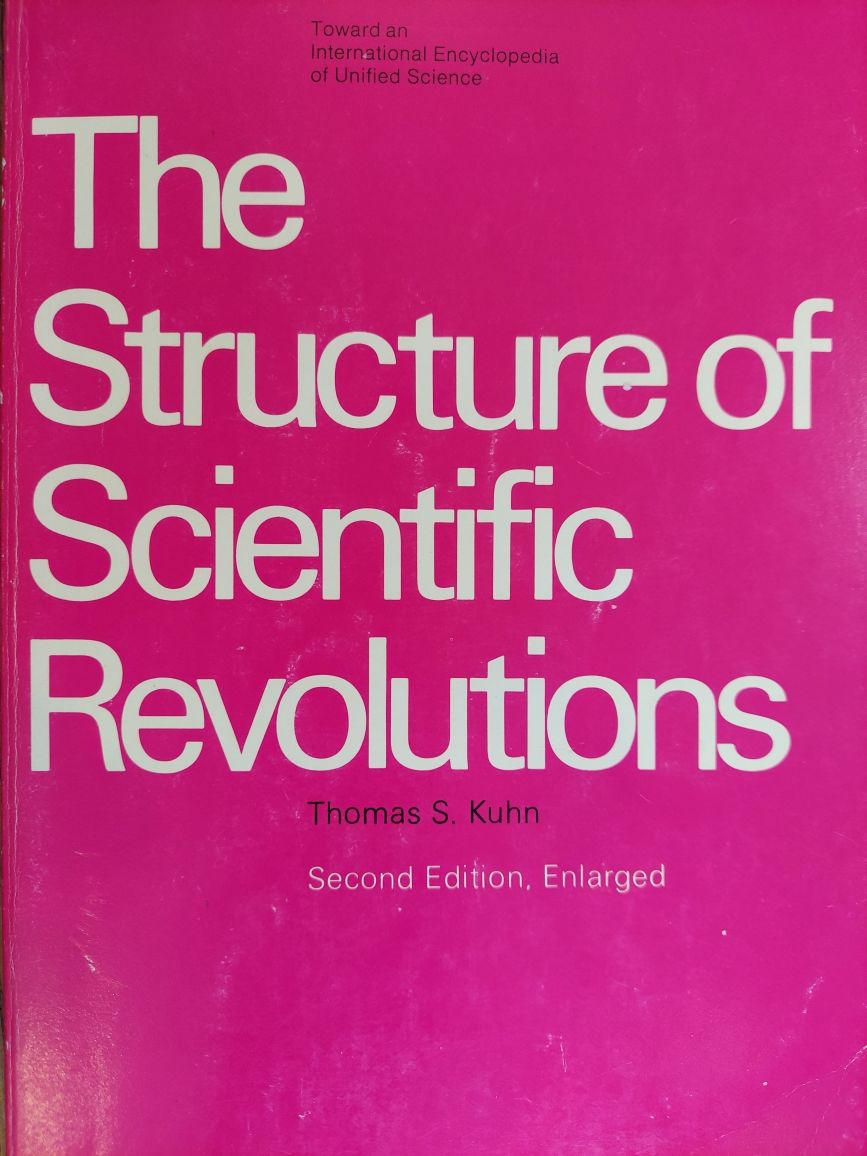
It is a 1962 monograph written by Thomas S. Kuhn that reshaped how scholars think about the history, philosophy, and sociology of science. Originally circulated as a chapter in the International Encyclopedia of Unified Science, it was later expanded and issued by the University of Chicago Press as a standalone book.
What is The Structure of Scientific Revolutions's core contribution?
The book introduces the idea of a paradigm shift, arguing that science does not simply pile up facts in a straight line. Instead, Kuhn describes long stretches of 'normal science' working within a shared framework, punctuated by abrupt revolutions that replace one framework with an incommensurable new one.
How does The Structure of Scientific Revolutions challenge the old view of scientific progress?
Kuhn pushes back against the 'development-by-accumulation' model that treated each new discovery as a brick added to an ever-growing wall. His episodic model holds that progress is discontinuous: communities of scientists solve puzzles within a paradigm until anomalies force a full reorientation of the field.
Why is The Structure of Scientific Revolutions important to fans of philosophy and theory?
It is widely regarded as a landmark text because it gave the sociology and history of science a vocabulary—paradigm, anomaly, revolution—that scholars across disciplines still use today. Its publication fundamentally altered debates about objectivity, rationality, and what counts as legitimate scientific change.
Where and how was The Structure of Scientific Revolutions first made available?
Kuhn first published the work as a monograph within the International Encyclopedia of Unified Science before the University of Chicago Press released it as a full-length book. That two-stage release helped the ideas travel from a specialized encyclopedia audience to a much broader academic readership.
More in Philosophy & Theory 1-24
Spotted an error? Know more?
This is a living reference — every entry is fact-audited, and reader corrections feed straight into our audit queue. Suggest an edit · See this site's audit record